TIME PIECES: THE DOUBLE ENTENDRE OF BESPOKE

Updated: Feb 22
There's a moment. Usually, after a comprehensive assessment of one's needs, and the order is made. It comes shortly after the fabric has been carefully selected, with linings and buttons to coordinate. Once the look is designed and ready to be crafted, the excitement bubbles over into a predictable question, triggered by a payment: How long will it take to get back?
In most cases, five-to-seven weeks, but it's not uncommon for a bespoke garment to need ten or twelve weeks.
[A stare of astonishment.]
You want to know why?
[An attentive nod.]
Let's just start with a suit. Okay.
Suits are two coordinating garments cut from the same cloth. So, a jacket and a pant are customary.
The jackets I make are Full Canvas and Fully Lined, though I have the option of half and quarter lining.
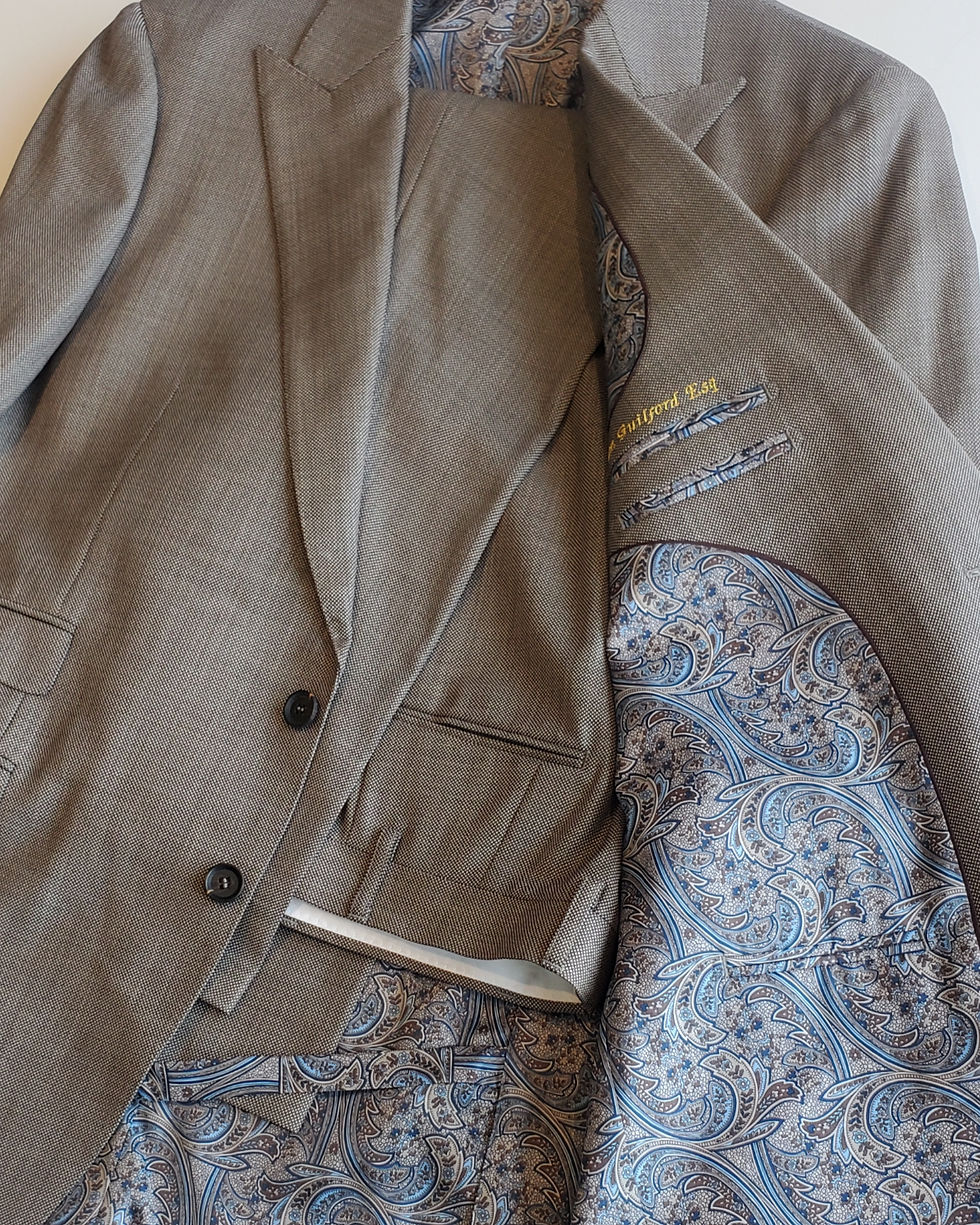
For the sake of this explanation, we'll stick to the classics. The lapels, pockets and center seams are often Pick Stitched, and the sleeves are finished with a Surgeon's Cuff on each. In addition to these beautiful details, the backs of my suit blazers are Double Vented with Straps, and it is my personal signature to have a French Interior and at least two Embroidered Inscriptions. These crafted works are done with a skill level that transcends time, but how long does it take to execute what I have named?
[A shoulder shrug]
Well...
A Full Canvas detail can take 40-60 hours, depending on the artisan's skill level. The process is lengthy. The first 1-2 hours is spent on cutting the canvas (typically from horsehair, wool, or a cotton blend) to match the jacket's front panels. The density of the canvas is adjusted to support the weight of the fabric and the desired silhouette of the suit. The second step is the pad stitching. This 4–6-hour process includes hand-stitching the canvas to the lapels and chest of the jacket, giving it its sculpted form. The next step is basting. This is where the canvas is temporarily stitched to the outer fabric to ensure its well-aligned and ready for sewing. It usually takes another 1-2 hours before the bulk work of the jacket assembly is done. The jacket must be assembled by sandwiching the canvas between the outer fabric and the lining.

To produce a Fully Lined jacket you must first prep the lining fabric. It's often a smooth, breathable material (e.g. Bemberg, silk, or viscose), that takes about an hour to be pre-shrunk and pressed to avoid the puckering and ripples we have all seen in poorly sewn garments. Once this step is complete, the lining must be cut to create the jacket pattern pieces, including seam allowances and making the notches for a smooth alignment. Another 2 hours. Then, the lining body must be assembled with the next 2-3 hours, adding the sleeves and leaving a small opening in the sleeve or side seam to turn the jacket out of, later in the process. Now, we are ready to attach the lining to the full-canvased jacket.
For 2-4 hours there is pinning and sewing, where the lining connected to the jacket's facings, neckline, hem, and sleeve cuffs. Sleeve cuffs that are made to function, with working buttonholes and buttons.
A Surgeon's Cuff is one of the most tell-tale signs of a custom garment. The process begins with 30-45 minutes planning the precise button placement, usually starting 2.5cm from the sleeve's hem. Then, an additional 30-minutes is invested, applying the interfacing to the inside of the sleeve to stabilize the fabric and prevent fraying. This is vital when working with the delicate and high-end fabrics we offer.
Next, a focused 30-45minutes is spent cutting the buttonholes with a cutter, specifically designed for the task. Precision is of the utmost importance, as to not compromise the jacket's integrity and symmetry.

Then, these new slits become the hand-sewn buttonholes of every garment we create. It takes about 4-hours to complete this task (about 30 minutes per button). Once the buttonholes are completed, the buttons are added. In our work, the last button is sometimes slightly askew, or a contrasting thread is applied purposely, as a sign of custom. At about 10-minutes per button, this equates to another 90 minutes spent toward this garment.
[An impressed eyebrow raises]
Still, I mentioned that my signature suits are created with a French Interior and Double Vented with Straps in the back.
The vents alone, add 1-2 hours to the pattern making process, ensuring proper length and symmetry, usually 6-10 inches in length on each side.
Those vents require 30-45 minutes of reinforcement. So, interfacing is added to stabilize the area. That means, about 2 more hours are given: to fold, press, and sew the vent facings. Then, the interior fabric must follow suit. Another 2 hours. Yet, a French Interior adds an additional level of craftsmanship to every suit jacket, with the introduction of piping.
First, the French Interior demands that the raw seams be hand-finished with silk or cotton tape, adding to the garment's durability. This is a 3-hour process that is well-worth the investment. And because the French Interior usually offers a hidden pocket, the lining customization can add another 2-3 hours to accommodate that or the monogramming.
Remember, I offer at least two embroidered inscriptions, directly on the jacket lining and my custom patch is added to every garment. So, 2 hours are allotted for those details, as well.
Finally, 2-4 hours is poured into the suit top for hand-finishing details, including: hand-sewn lining to the facings, hem and sleeve heads. Then, pick-stitching tells "those who know", this jacket was made for you.
[A blink of disbelief]
Yes. So, you see. These are "time pieces". They take time to make. One jacket. At least, 40 hours of work.
Yet, the time is not so literal, either. There is a poetic equivalent to the "era of time" these pieces are created in. They capture the modern times, while they honor an era of the past through craftsmanship passed through the generations. Again, reinforcing that concept of being a "time piece" in all contextual understandings of the phrase.
Our clothes define the times we're in.
We live in them. The fabrics and silhouettes define our contributions to history and become cultural indicators.
The shirtwaist dress of the 40s and 50s, the shift dress of the 60s, the polyester and bell bottoms of the 70s. The clothes dressed the decade... And I'm a 90s girl, where oversized and color-blocking were statements of our attitude for everyone to see.
Today is no different. The pieces we create, are the watch faces of this era. In the place of hours and minutes, our clothes capture our culture and explain the relevant culture we are living through, now.
Yes. I get it. Though, I've never thought of it that way. Clothes, as time pieces.
They are time pieces, indeed.
I'll leave you with this....
Not only do these clothes speak of where we are and where we have been, but as we make them for events yet to come, they also hold the future.
Not just because we make them with the upcoming wedding or approaching season in mind, but also because one day, far from now, we will be the era to draw inspiration from. People will look back on the 2020's as we do the 1920's, and they will build on our designs.
When you think of it this way, what is five-to-seven weeks to set the tone for future decades?
[Laughter] Yes.
That's all the time it will take to cause a ripple in history for many years to come. All it will take to do our part in the Big Picture of How We Left Our Mark on the Future.
And I didn't even have to explain what goes into the making of pants, today.
So, I consider this: Time well spent.
___
. . . . . . .


Comments